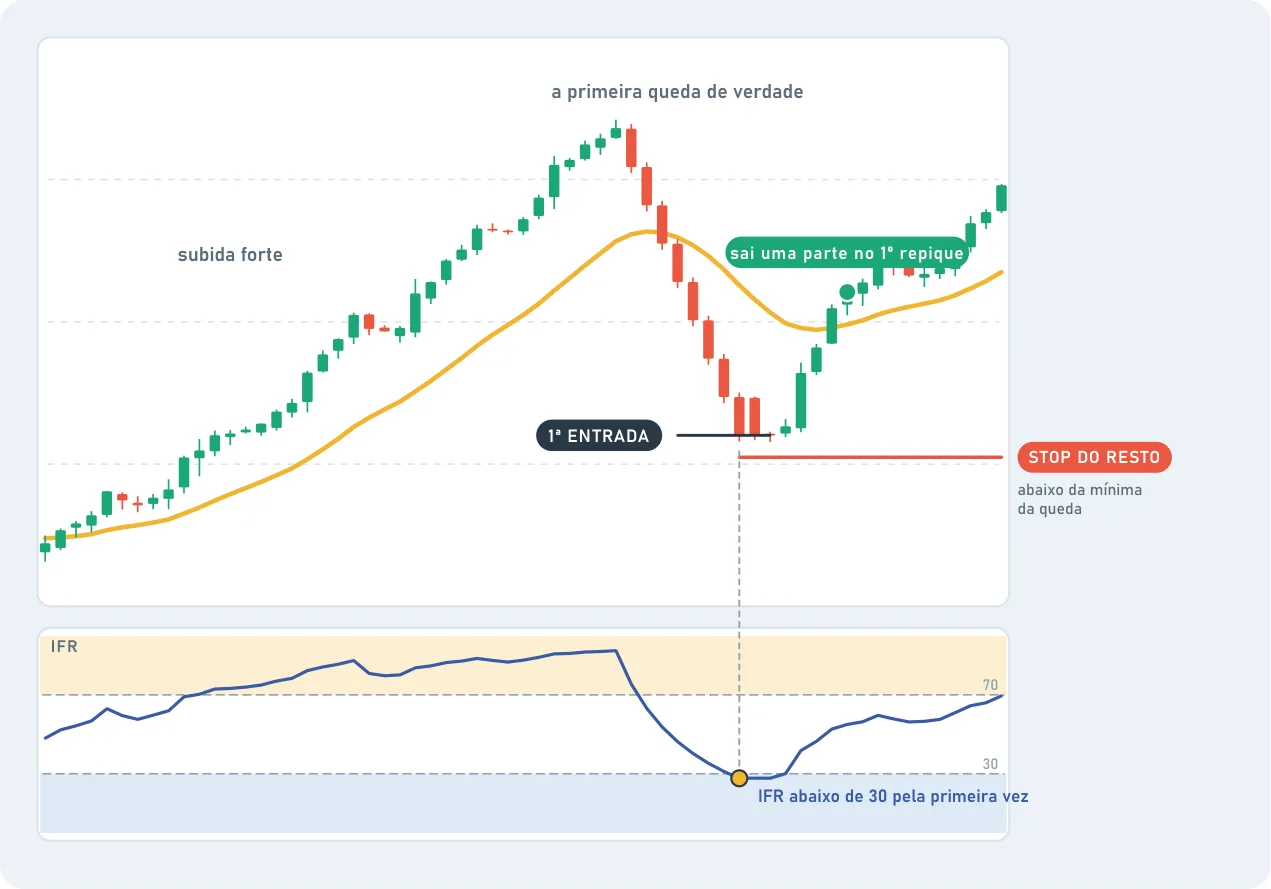
The first drop after the party. The Back Burner is a bounce inside a strong uptrend. The idea: instead of buying while the price is stretched, wait for the first real drop.
Why it works. When an asset rises very fast, a lot of people who missed it think it's too expensive to get in. They sit and wait for a chance. On the first strong drop, they all get in together, and that can create a quick bounce.
The signal. After a strong rise, the RSI on the 5-minute or 1-hour chart drops below 30 for the first time.
When it applies and when it doesn't.
It applies when the drop is technical: people taking profit after a strong rise.
It doesn't apply when the drop comes from genuinely bad news: weak earnings, a change at the company, something that changes the story.
It applies to heavily traded assets (remember , Level 1). On thinly traded assets the RSI lies.
It applies when the drop is fast, a cascade. A slow, dragging drop just cools off the RSI without wearing out the sellers.
It helps if that asset already has a history of bouncing hard from oversold.
Line up the timeframes. The first oversold reading on the 5-minute can mark a higher low on the 1-hour. The first oversold reading on the 1-hour can mark a higher low on the daily.
One way to set it up (an example, not a rule).
1st entry: part of the position when the RSI drops below 30.
2nd entry: money held back in case the drop continues and the RSI gets close to 20. Only if it was already in the plan.
Stop: set by how much you're willing to lose, because at that point there's often no previous . The stop is there so a bounce trade doesn't turn into a long-term investment because you wouldn't accept the loss.
Exit: on the first bounce, the first part comes off, and the stop for the rest moves below the low of the drop. The other two come off like in chapter 16.
The reverse. The same reasoning works the other way around in a strong downtrend: the first overbought reading after the drop.