Translation under review. The illustrations are still in Portuguese.
You stopped in the middle of this chapter.
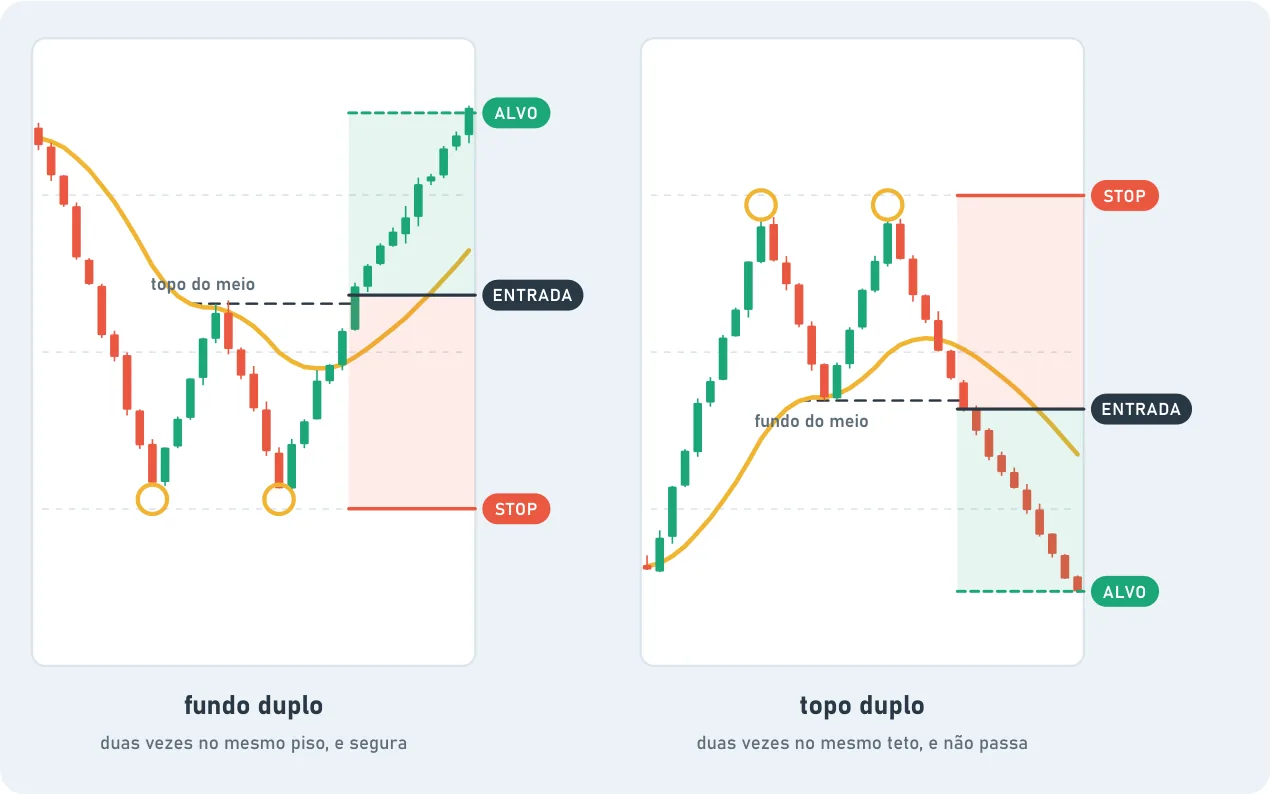
What it is. The price goes to the same place twice and can't get past it. In a double bottom, it falls twice to the same floor and holds both times, forming a W. In a double top, it rises twice to the same ceiling and fails to get through both times, forming an M. Between the two attempts there's a point in the middle: the middle top (in the W) or the middle bottom (in the M).
What it means. In a double bottom, the sellers tried to push the price down twice, and the buyers held both times. On the second attempt, the sellers already have less strength. In a double top it's the opposite: the buyers tried twice and didn't get through.
The confirmation. The pattern is only complete when the price gets past the middle point: above the middle top in a double bottom, below the middle bottom in a double top. Before that, it's just a price bumping into or .
One way to set it up (an example, not a rule).
Entry: when the price gets past the middle point.
Stop: beyond the two bottoms (or the two tops).
Exit: in three parts (chapter 16). One reference people use is the height of the pattern, measured from the middle point.
The whole trade. The trade drawn step by step in chapter 16 is a double bottom, from start to finish.
When it dies. The price gets past the middle point and comes back, or breaks the two bottoms (or the two tops).
Words in this chapter
Support
A price area where drops tend to run into buyers.
Resistance
A price area where rises tend to run into sellers.