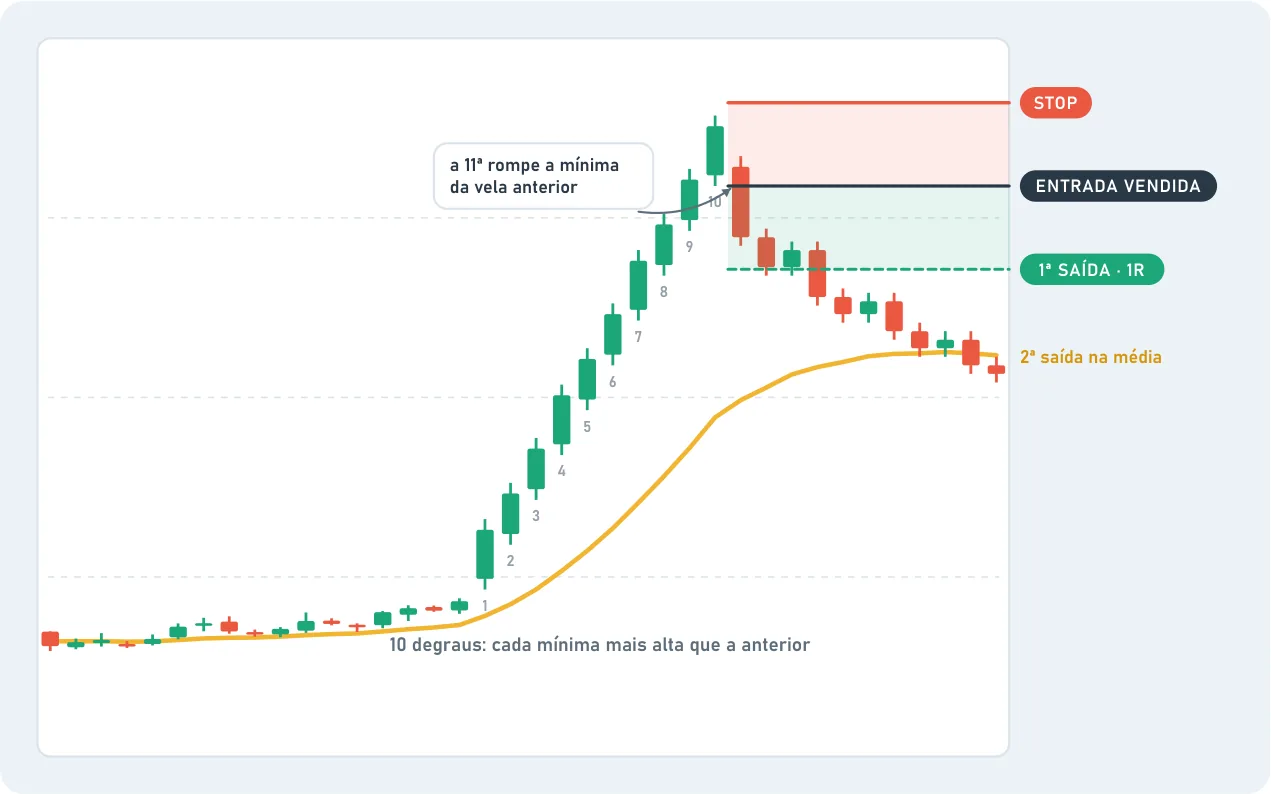
The staircase that gets tired. The Stair Step (steps on a staircase) is a against the short-term move. It waits for a long run of candles in the same direction, about 8 to 10 steps or more, and the entry happens when the staircase breaks.
On the way up: each candle has a higher low than the one before. The short entry happens when the price breaks the low of the previous candle.
On the way down: each candle has a lower high. The long entry happens when the price breaks the high of the previous candle.
The entry is at the moment of the break, without waiting for the candle to close. The idea is to catch the moment the short-term strength fails.
The big chart decides. Since you're going against the short-term strength, the bigger picture is what gives you the odds. A rising staircase on the 5-minute makes more sense for this setup when the 4-hour or the daily is already stretched, close to making a lower high.
One way to set it up (an example, not a rule).
Entry: on the break of the previous candle's low (or high).
: tight, just beyond the recent high (or low), with a little room. Since the entry is right next to the extreme, the risk stays small.
Exit: the idea is to take the risk off fast. When the price moves in your favor the same distance as the stop (1R, chapter 17), the first part comes off and the stop moves up to the entry. The second comes off at the moving average or at a on the bigger chart, and the last one stays with the stop near the second exit (chapter 16).
Two ways to trade it.
| Aggressive | Conservative |
|---|---|
| Staircase length 6 candles is enough | 10 candles or more |
| Bigger chart matters less | has to agree |
| Exit the first part early, on the first bounce | the three parts from chapter 16 |