Translation under review. The illustrations are still in Portuguese.
You stopped in the middle of this chapter.
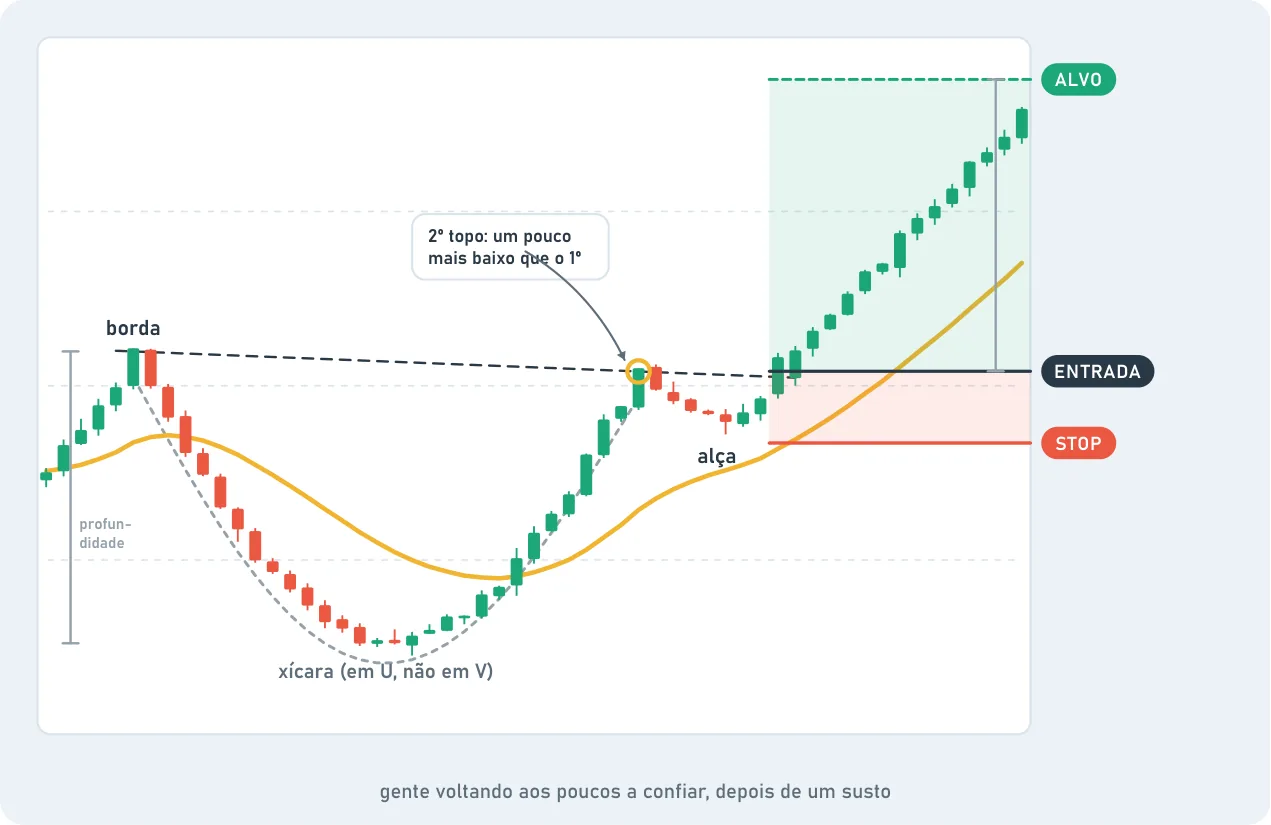
What it is. A drop followed by a slow, U-shaped recovery, up to about the height where the price started falling. That curve is the cup, and the top level on both sides is the rim. Then comes a small breather down, near the rim: the handle. When the price the rim, the pattern is complete.
What it means. After a scare, people don't trust again all at once. First they selling. Then they come back little by little, and the bottom gets rounded, in no hurry. Near the rim, people who bought up high and got stuck take the chance to get out at break even: that's the handle. Once those sellers are done, the road is clear.
The shape matters. The bottom of the cup is rounded, a U, not a V. The second top, right before the handle, is a little lower than the first. This detail is very important: it shows there are still people selling near the rim, and the handle is what finishes clearing out that selling. The handle is small and sits in the top half of the cup. A handle that drops too deep isn't a handle anymore.
How to draw it. A line on the rim, connecting the two tops of the cup. Since the second top is a little lower, the line tilts slightly down. The handle is the breather after the second top.
One way to set it up (an example, not a rule).
: on the breakout of the rim.
Stop: below the low of the handle.
Exit: in three parts (chapter 16). One reference people use is the depth of the cup, measured from the rim.
When it dies. The price breaks the rim and falls back into the handle, or loses the low of the handle.
Words in this chapter
Breakout
When the price breaks through resistance on the way up, or through support on the way down.