What an option is. An option is a contract that gives the buyer the right, but not the obligation, to buy or sell an asset at an agreed price (the ) until a certain date (the ). The buyer pays for that right: the .
Call: the right to buy. It gains value when the price goes up.
Put: the right to sell. It gains value when the price goes down. That's why it's also used as protection, similar to insurance.
An example, with made-up numbers. A stock is at R$100. A put with a R$95 strike, expiring two months from now, costs R$2. Whoever buys this put pays R$2 for the right to sell the stock at R$95 until expiration, no matter what happens to the price.
If the stock falls to R$80, that right is worth at least R$15: it's being able to sell for R$95 something that's worth R$80 in the market. If the stock rises to R$110, nobody wants to sell for R$95. The put expires worthless, and the buyer loses the R$2.
The clock runs against the buyer. An option has an expiration date. If the price stands still or takes too long, it loses value every day and can turn to dust at expiration. If you buy options, you can lose 100% of what you paid. That's why "it's really cheap" says nothing about the odds of it working out: lots of cheap bets that turn to dust add up to a big loss.
The option seller. On the other side of every buyer there's a seller. The seller receives the premium now and takes on the obligation. A comparison: it's similar to an insurance company, which collects the monthly payment and pays out if the accident happens. Most of the time the insurance company keeps the payment. But if the market moves a lot against the seller, the loss can have no limit. That's why there are ways to sell with a limited loss: covered selling (the seller already holds the asset or has the cash set aside) and spreads (the seller also buys another option, and the structure itself limits the maximum loss).
How the big money protects itself. A fund pools money from lots of people, and a manager decides where to put it. A fund's first goal is not to lose money, before making any. The big players almost never bet everything on one direction: they have a main idea and, on the side, protection in case they're wrong. And big money doesn't get in or out all at once. If a fund tried to sell everything in one day, it would knock the price down itself. That's why, many times, instead of selling, it protects.
The hedge, step by step. Hedge is the name for that protection. With the same made-up numbers:
The position. A fund holds a lot of shares it bought a while ago and doesn't want to sell: it's a long-term position, and selling all of it would move the price. The stock is at R$100, after a long rise.
The doubt. The chart shows signs of fatigue near a top: a on the RSI (chapter 13), or the price losing the moving average (chapter 10). A drop may be coming, and nobody knows.
The protection. Instead of selling the shares, the fund buys puts with a R$95 strike. It pays the premium, like someone paying for insurance.
If the price falls. The shares lose value, but the puts gain. One part makes up for the other.
One approach that Dan (The Chart Guys) says he uses: when the puts are already in profit, he sells half of them. That money pays for the whole insurance, and the other half keeps protecting, now at no cost.
- If the price rises. The puts lose value and may expire worthless. The fund lost the premium, but the shares kept going up. The premium was the cost of the protection.
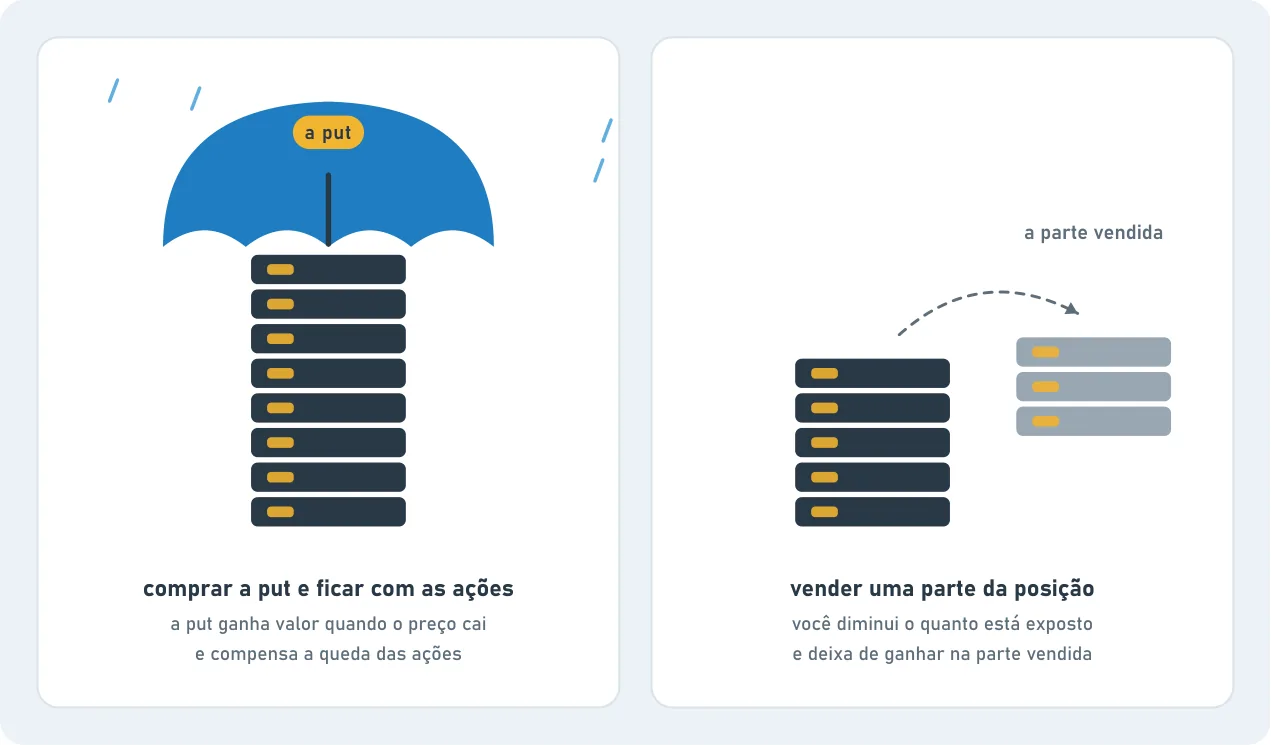
Two ways to protect yourself. Buying the put isn't the only path. If you have a position and think a drop is coming, you can also sell part of it. Each path has its cost:
| Buy the put and keep the shares | Sell part of the position | |
|---|---|---|
| How it works | The put gains value when the price falls and makes up for the drop in the shares | You sell part and reduce how exposed you are |
| If the price rises | The put turns to dust, you lost only the premium, and the shares keep gaining | You miss out on the gain on the part you sold |
| Cost | The premium, and the clock | No premium, but you miss the rise on that part |
| Good for | Protecting, near a top, a long-term position you don't want to sell | Reducing the size for good |
What the hedge is for, and what it isn't for. The hedge is a tool to protect a long-term position near a top. It's not for fixing a trade that's already losing. In a trade, the answer to a loss is the stop (chapter 17), not insurance bought afterward.
Options instead of borrowed money. A call gives you large exposure for a small amount, and the most the buyer can lose is the premium. With ordinary leverage, a sharp drop can wipe out the account and still leave you in debt. With the call, the worst case is that it expires worthless. Both have risk, and each person needs to understand which one they're taking.
Open interest: the money on the table. Open interest is the number of option contracts that are still open. Remember chapter 9 of Level 2: where there are a lot of contracts betting on a price, there's a lot of money on the table.
If the price moves and open interest rises with it, it's a sign that new money is joining the bet. Near expiration, a lot of people watch the prices with many open contracts. Sometimes the price hovers near them. Sometimes it doesn't.