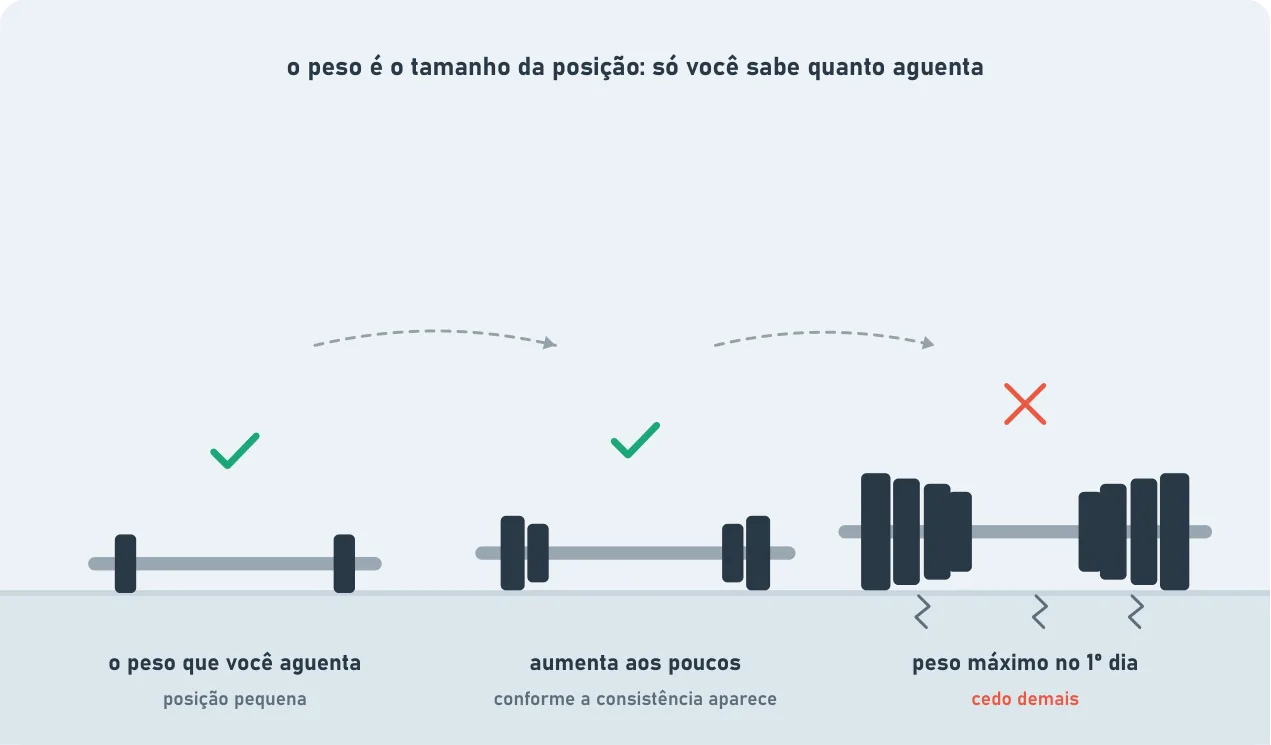
The gym. A comparison with the gym. Nobody walks into the gym on day one and puts on the max weight. Each person knows the weight they can handle, and nobody can know that for them. Trading is similar: the weight is the size of your position, and only you know how much you can handle.
The is not optional. The stop is an order that closes the trade on its own when the price reaches a point you decided on beforehand. It's the emergency brake. It's set before the entry, by the chart (where the idea dies), and it's never moved further away later because the price went against you.
How much to risk is your call. This book doesn't tell you how much to risk, and no number works for everyone. What makes sense in one account doesn't make sense in another, and what works for one person doesn't work for another. Do your own research (DYOR) and think about what's best for you. Only one question matters: how much are you willing to lose on this trade, knowing that you might lose it?
A simple calculation. Once you've decided how much you're willing to lose, the size of the position comes from one division:
- The pain limit: how much you're willing to lose on this trade. Only you decide.
- The risk per share: the distance between the entry and the stop.
- The division: the pain limit divided by the risk per share gives you how many shares fit in the trade.
If the stop is further away, you buy less. If it's closer, you can buy more. How much you're willing to lose stays the same.
R: the risk ruler. What you risk on a trade is 1R. If you lost what you risked, it was -1R. If you made twice what you risked, it was +2R. Measuring in R lets you compare trades of different sizes and see whether your strategy works.
Why losing little matters so much. Losing 10% means you need to gain 11% to get back. Losing 50% means you need to gain 100%. The bigger the hole, the harder it is to get out.
: the 100x example. With 100 times leverage, a move of just 1% against you wipes out the account. In futures, the price can move 1% on an ordinary day. At 100x, an ordinary day finishes you. And fees are charged on the whole position, not just on your money, so you start out losing before the price even moves. High leverage isn't trading, it's betting on noise.
If you can't win small, you won't win big. If you're not profitable with 1 contract, trading 10 just makes you lose ten times faster.