Translation under review. The illustrations are still in Portuguese.
You stopped in the middle of this chapter.
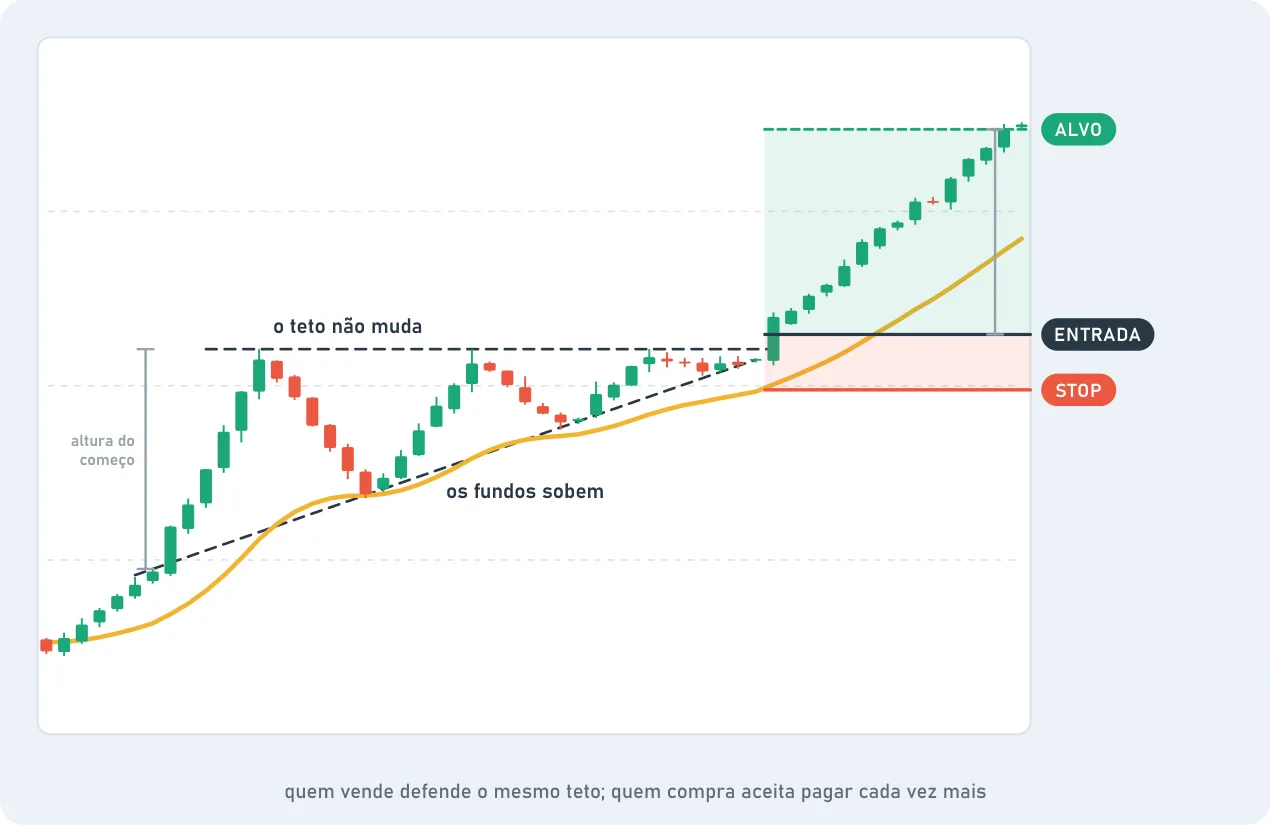
What it is. A flat ceiling, where the price hits and turns back several times, and higher and higher bottoms underneath. There are two lines: a flat one on top and a rising one below. The price gets squeezed between them.
What it means. Sellers always defend the same price up top. Buyers are willing to pay more and more: each drop stops higher than the last. Every time the price comes back to the ceiling, there are fewer sellers left there. One day the ceiling may give way.
How to draw it. A flat line connecting the tops, which sit at the same height. A rising line connecting the bottoms. Two touches on each line are enough to draw it. A third touch gives you more confidence.
The confirmation. The price closes above the ceiling. Sometimes it comes back to test the ceiling from above, and the old ceiling becomes the floor (chapter 1).
One way to set it up (an example, not a rule).
Entry: on the of the ceiling, or on the retest from above.
Stop: below the last higher bottom.
Exit: in three parts (chapter 16). One reference people use is the height of the start of the triangle, measured from the ceiling.
When it dies. The price loses the bottom line, the one connecting the rising bottoms. The buyers stopped paying more.
Words in this chapter
Breakout
When the price breaks through resistance on the way up, or through support on the way down.