What an is. An edge is an advantage: a way of trading that, repeated many times, ends up positive. It's not a strategy that's always right. It's one that, adding up the wins and losses of many trades, leaves you with more money than it takes.
The three pillars.
You. Your way of trading has to fit your personality. If you like speed, you do better with short trades. If you're patient, you do better waiting for the extremes. Remember the rhythm, in Level 1: dance to the music that suits you.
Keep it simple. Don't load the chart with decorations, like a Christmas tree. A lot of people do better with two or three setups they know deeply than with all of them known halfway.
Test first. A setup doesn't become an edge because it worked three times. Go back on past charts and test it in up, down and sideways markets, calm and wild ones. Write down each case.
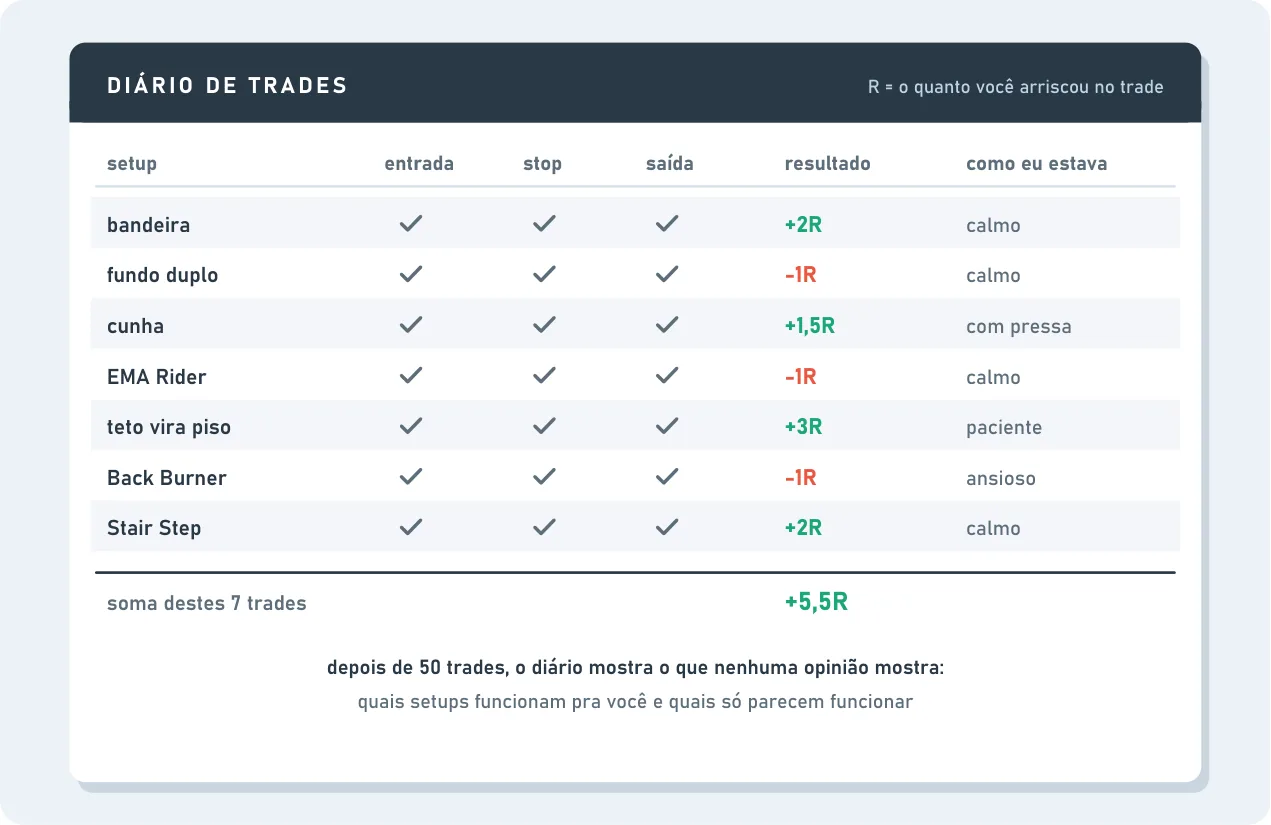
The journal. Write down every trade: the setup, the entry, the stop, the exit, the result in R, and how you were feeling. After 50 trades, the journal shows what no opinion can: which setups work for you and which only seem to work.
Where to start testing. The easiest setups to test are the ones with a very clear entry and stop.
| Setup | Why it's good for starting to test |
|---|---|
| Back Burner (chapter 8) | Clear signal: the first oversold reading after a strong rise |
| Double top and double bottom (chapter 6) | The stop sits just past the bottom or the top, a well-defined risk |
| Stair Step (chapter 9) | Entry and stop right next to each other, small risk |
| Opening range (chapter 19) | The range marks where to pay attention and where the stop goes |
| EMA Rider (chapter 10) | The moving average shows the trend and shows when it ends |
| that doesn't fill (chapter 12) | It shows strength in the direction of the gap |
Your edge changes. The market changes phases. A setup that worked in an up year can stop working in a sideways year. Review your journal from time to time and adjust.
The end of the book, the start of the work. You've reached the end. Now you know what the market is, you know how to read a chart and you have a tool belt full of tools. None of them is a recommendation. All of them are yours. Study, test and take notes. And when you have questions, we're at lastro3.com.